
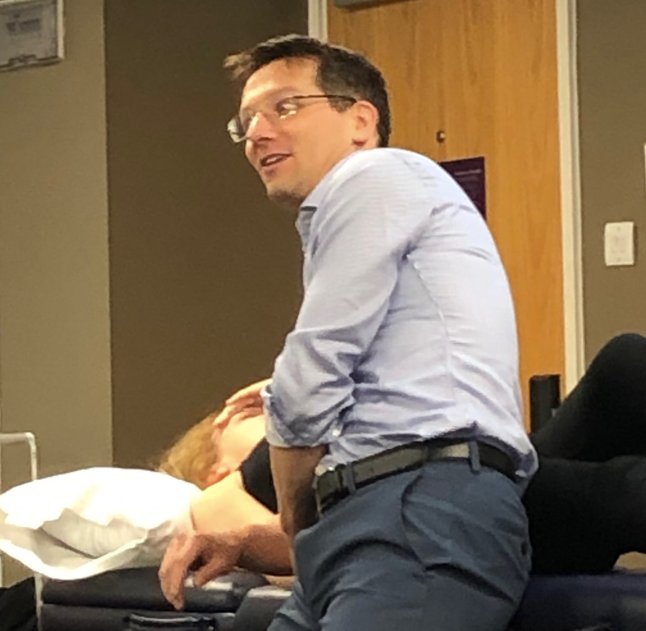
Most patients with persistent foot, ankle or lower-limb pain have already tried the obvious things — rest, exercises, insoles, sometimes injections. When those don’t fully resolve symptoms, it’s often the fascial system that hasn’t been addressed.
We’ve added the Stecco Method of fascial manipulation to the treatments we can offer for lower-limb musculoskeletal problems. Lee and Bob both completed Levels 1 and 2 of the technique under Antonio Stecco, one of the founders of the method.
What is fascia, and why does it matter?
Fascia is the connective tissue that wraps every muscle, bone, blood vessel and nerve in the body. It is arranged in three thin sheets that need to glide over each other to allow normal movement. When that glide is disturbed — through injury, overuse, surgery, or simply a long-standing movement pattern — the result can be pain, restriction, or referred symptoms in places that look unrelated to the original problem.
The Stecco Method maps specific points on the fascial network that, when treated, restore that glide. There are two main groups of treatment points: Centres of Coordination and Centres of Fusion. Choosing which points to work on is informed by movement testing rather than guessing from where the patient feels the pain.
What an appointment looks like
A fascial manipulation session takes around an hour. Most of that time is the assessment. We use a series of movement tests to identify which fascial line is involved and which specific points need treatment. The hands-on treatment itself is firm and can be uncomfortable while it’s being done — that’s expected, and patients generally feel a noticeable improvement in movement and symptoms within a day or two.
Fascial manipulation is one of several tools we use within the wider MSK and sports podiatry service. It often works well alongside orthoses, gait re-training and a targeted exercise programme.
When it might be worth trying
Fascial manipulation is worth considering when:
- You’ve had persistent lower-limb pain that hasn’t responded to standard treatment
- You have referred pain that doesn’t fit a single anatomical structure
- You feel restriction or stiffness rather than acute injury
- Previous treatment has helped but not fully resolved the problem
It is not a first-line treatment for everything. We’ll usually recommend it after a full biomechanical assessment so we know how it fits into the wider plan.
Book an appointment or make an enquiry → — Leeds, York, Wetherby and Wharfedale.
Lee Short MSc DPodM and Bob Longworth MSc DPodM are directors and senior podiatrists at Podiatry Clinics (Yorkshire) Ltd.