
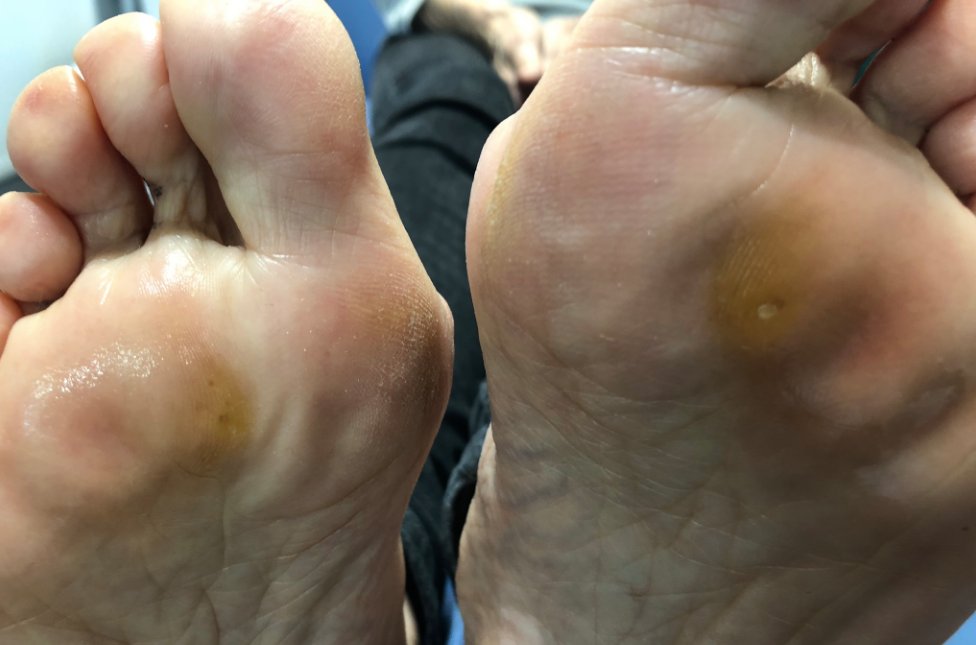
Corns are one of the most common reasons people book a podiatry appointment, and one of the easiest things for us to deal with. They’re also one of the most likely problems to come back if the underlying cause isn’t addressed.
What’s the difference between a podiatrist and a chiropodist?
It’s a question we get asked a lot. Podiatry is the umbrella profession — it covers everything from nail and skin care through to biomechanics, surgery and musculoskeletal treatment. Chiropody is the part of podiatry that deals with nails, corns and calluses. So all chiropodists are podiatrists, but most modern UK practitioners use “podiatrist” because the scope of practice is broader than chiropody alone.
Either way, removing a corn is a routine chiropody appointment.
What is a corn?
A corn is a small, dense plug of hardened skin that forms in response to repeated pressure or friction at one specific point on the foot. It’s the body’s protective response — the skin thickens to defend itself — but the plug itself then presses inward into the softer tissue underneath, which is what causes pain.
There are several common types:
- Hard corns — the most common. Found on the tops of toes or under the ball of the foot.
- Soft corns — usually between the toes, where moisture keeps the skin softer.
- Seed corns — small, multiple, often on the underside of the foot. Generally not painful.
- Vascular or neurovascular corns — contain blood vessels or nerves and need careful treatment.
How we treat them
Removal in clinic is quick. We use a sterile scalpel to debride the surrounding callus and then carefully enucleate the central plug. Done correctly, it’s painless, and patients often feel a noticeable difference in the affected area as soon as they stand up. A typical treatment takes 15 to 20 minutes within a chiropody appointment.
If a corn has formed under high pressure — for example under a metatarsal head or against a clawed toe — we’ll often add a temporary padding or insole adaptation to take the pressure off while the skin recovers.
How to stop them coming back
A corn that’s removed and then re-exposed to the same pressure will simply re-form. So the second half of the appointment is usually the more important part: working out why the corn appeared in that exact spot, and what to change so it doesn’t keep returning.
Common contributors include:
- Footwear that’s too narrow, too shallow or too rigid in the wrong place
- A bunion or hammer toe pushing one toe against another
- A high-arched or low-arched foot loading one part of the sole more than the rest
- Reduced fatty padding under the metatarsal heads (common with age)
- A gait pattern that overloads one zone of the foot
For straightforward cases we can often resolve things with a footwear change and routine maintenance. Where there’s an underlying biomechanical cause, a custom or adapted orthoses can offload the affected area, and a gait analysis helps us understand exactly where the load is going.
When to come and see us
If a corn is painful, recurring, or you have diabetes or any condition affecting circulation or sensation, don’t try to treat it yourself with corn plasters or blades. Salicylic acid corn plasters can damage healthy surrounding skin, and home-cutting carries an infection risk. A 30-minute clinic appointment is safer and more effective.
Book an appointment or make an enquiry → — Leeds, York, Wetherby and Wharfedale.
See our fees page for routine chiropody pricing.
Lee Short MSc DPodM and Bob Longworth MSc DPodM are directors and senior podiatrists at Podiatry Clinics (Yorkshire) Ltd.