
Most recreational runners don’t run because they want to be measured. They run because they enjoy it, want to stay fit, or have a target event in mind. But when something starts hurting — or when progress stalls — having objective data on how you actually run can be the fastest route back to running well.
What 3D gait analysis tells us
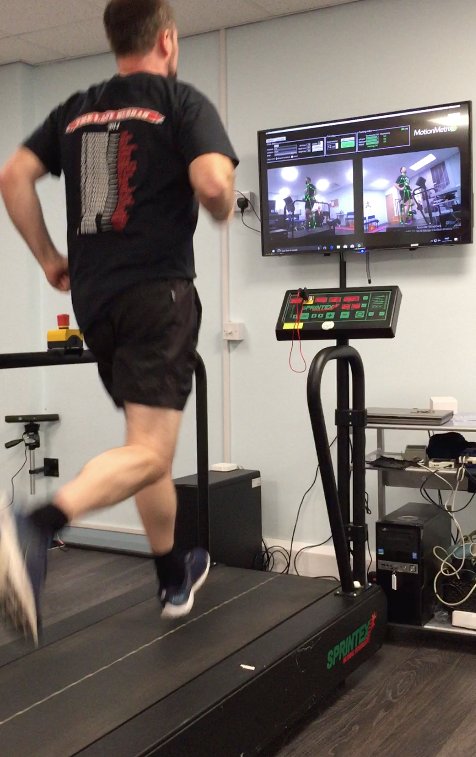
We use MotionMetrix at our York and Leeds Clinics. It captures your running technique in three dimensions and compares it against population data, including elite distance runners.
The variables we look at most closely are:
- Cadence — how many steps per minute you take
- Step length and vertical oscillation — any over-stride and how much you bounce
- Hip and knee flexion through the gait cycle
- Foot strike position relative to the centre of mass
- Ground contact time and flight time
- Pelvic drop and other indicators of trunk or hip control
These aren’t measurements for the sake of measurement. Each one has evidence linking it to running economy, mechanical load, or the loading patterns associated with some lower-limb injuries.
Why this matters for injury and performance
The research on running re-training is reasonably consistent: small, deliberate changes to a few key parameters can help reduce the kind of mechanical load linked with some running injuries, and can improve running economy. Evidence based interventions can include increasing cadence, reducing over-striding (where the foot lands too far ahead of the body’s centre of mass) and hip drop.
The challenge for most runners is that you can’t reliably change what you can’t see. Coaching cues and “try to run lighter” advice rarely lead to lasting technique change without objective feedback. That’s where the analysis earns its keep — you see exactly what you’re doing now, what to change, and whether the change has actually held when you re-test.
What an appointment looks like
A typical session takes around 90 minutes:
- A short biomechanical assessment — joint range, foot type, any current symptoms
- Treadmill running while the system captures your gait in 3D
- A walk-through of the data, with comparisons to elite-runner reference values
- A targeted set of recommendations — usually one or two technique changes plus any strength or mobility work
- Re-test on a follow-up to confirm the changes have stuck
If you’re rehabbing from injury, we’ll usually combine the gait analysis with MSK and sports podiatry and, where indicated, orthoses. For the wider service overview see gait analysis.
Who it’s for
Gait analysis is worth doing if you’re:
- Returning from a running injury and want to look at the loading patterns that may have contributed to it
- Stuck at a performance plateau despite training consistently
- Preparing for a longer race and want to run more economically
- New to regular running and want to start with reasonable technique
It’s also useful for runners who’d like objective data on their gait rather than an impression-based assessment.
Book an appointment or make an enquiry → — running analysis is available at our York and Leeds Clinics.
Lee Short MSc DPodM is a director and senior podiatrist at Podiatry Clinics (Yorkshire) Ltd.