
A patient came to see us recently with new pain on the inside of her ankle. She had been wearing a pair of £450 insoles prescribed elsewhere, and her tibialis posterior tendon — which had been asymptomatic before — had become painful and showed signs of damage on assessment. It’s a useful reminder that with foot orthoses, what matters isn’t the price tag. It’s whether the device is doing the right thing at the right phase of the gait cycle.
What is the tibialis posterior?
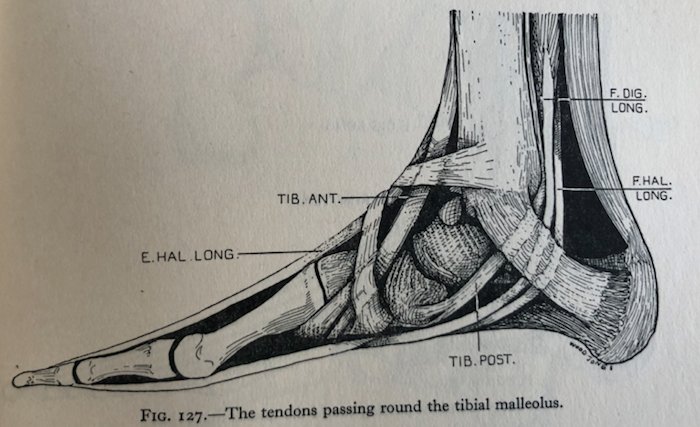
The tibialis posterior is a deep calf muscle that attaches to the back of the tibia and runs as a tendon down the inside of the ankle. It’s one of the main supports for the inside of the foot. When it’s overloaded — usually in feet that pronate more than they should — it can develop tendinopathy, partial tears, or in advanced cases the kind of progressive flatfoot deformity we cover in detail on our tibialis posterior dysfunction condition page.
The tendon does two distinct jobs in walking. In midstance, it slows the rate at which the arch lowers as your weight transfers onto the foot. Then in terminal stance, as the heel lifts off the ground, it works again to help raise the arch and stiffen the foot for push-off. Any treatment plan has to respect both of those windows.
Where the £450 insoles went wrong
The insoles in question had a high medial arch — reasonable, in principle, for a pronating foot — but the front of the device had a “first ray cut-out”. That’s a common adaptation where material is removed from under the big toe joint to allow it to dorsiflex more freely. It can be useful in some forefoot presentations, but in this case the combination didn’t suit the patient.
As her heel lifted, there was no support under the inside of the forefoot but full material under the outside. The foot was directed into pronation at the same point in the gait cycle that the tibialis posterior was working to invert and stabilise it. Loading the tendon against that mechanism repeatedly is a plausible route to symptoms developing where there were none before, which is what we saw clinically.
When the new pain appeared, the original advice had been to persevere with the device. She came to us for a second opinion, and we adjusted the approach from there.
How we approach insole therapy
A well-prescribed insole isn’t about cost. It’s about where you place force, when you place it, and how the device fits the patient’s specific gait pattern. The insoles we use and adapt in clinic typically run between £40 and £80 — and most patients don’t need them indefinitely, just long enough to get the underlying tissue settled and back to baseline.
When we assess a patient with suspected tibialis posterior dysfunction, we’ll usually combine a few things:
- A full biomechanical and gait assessment, often with 3D gait analysis at our York clinic running lab
- An off-the-shelf or custom orthosis, adapted in clinic to suit the foot
- Targeted strengthening and stretching for the tendon and surrounding tissues
- Joint mobilisations and, where relevant, fascial manipulation
- Injection therapy in selected cases, where clinically appropriate
The full range of biomechanical and tissue-based treatments we offer sits under MSK and sports podiatry, and the device side is covered on our orthoses page.
When to come and see us
If you’ve got persistent pain on the inside of your ankle or arch, an arch that feels like it’s collapsing, or insoles that don’t seem to be helping, a proper biomechanical assessment is a sensible starting point. We see this presentation regularly. The right device for the job is often a relatively simple one, well chosen.
Book an appointment or make an enquiry → — Leeds, York, Wetherby and Wharfedale.
Bob Longworth MSc DPodM is a director and senior podiatrist at Podiatry Clinics (Yorkshire) Ltd.